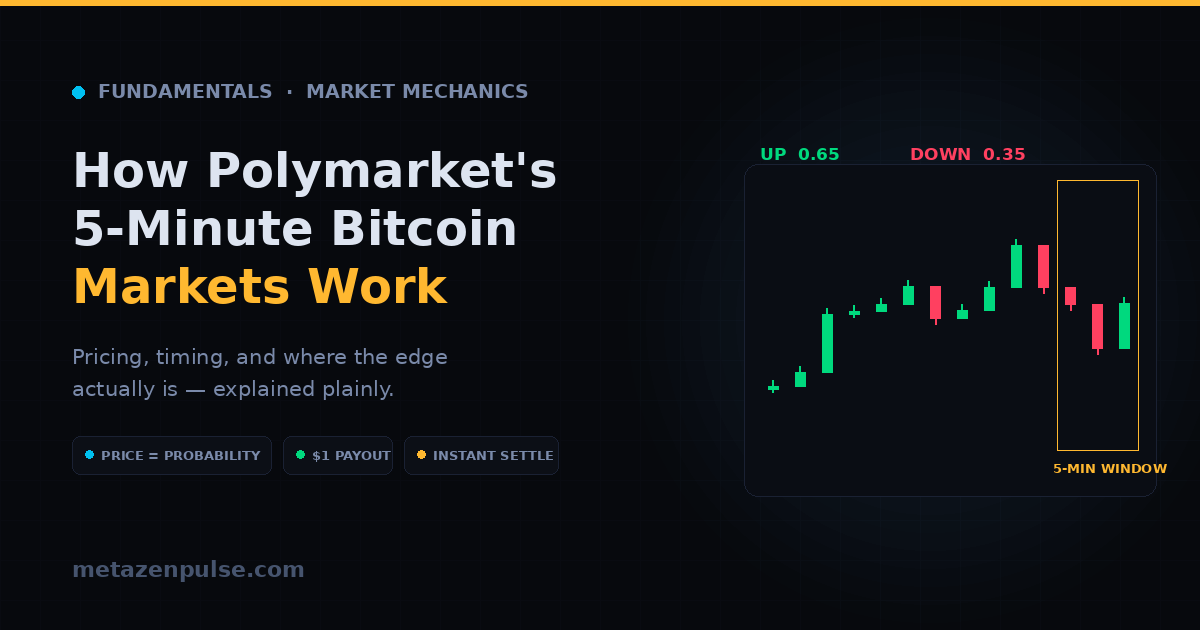
Polymarket added 5-minute Bitcoin Up/Down markets in February 2026, alongside the 15-minute versions that were already among the platform's most actively traded crypto markets. They look deceptively simple: pick Up or Down, wait a few minutes, get paid or don't.
That simplicity hides mechanics that determine whether you profit or slowly bleed. This is a plain explanation of how the markets actually function — the pricing, the timing, and where an edge realistically exists.
The basic structure
Every 5 minutes, a new market opens asking one question:
Will Bitcoin's price be higher or lower when this 5-minute window closes than it was when the window opened?
You buy shares in one of two outcomes: Up or Down.
- If you're right, each share pays out $1.00
- If you're wrong, each share pays $0.00
That's the entire instrument. There's no leverage, no liquidation, no funding rate. Your maximum loss is exactly what you paid for the shares, and your maximum gain is $1.00 per share minus what you paid.
The 15-minute markets work identically with a longer window. Polymarket runs the same structure for other assets including Ethereum and Solana.
Price is probability
This is the single most important concept, and it's where most newcomers go wrong.
A share's price is the market's estimate of the probability that outcome happens.
If "Up" is trading at $0.65, the market collectively believes there's roughly a 65% chance Bitcoin closes higher. Buy at $0.65 and you're risking $0.65 to win $0.35.
Prices always sit between $0.00 and $1.00, and the two outcomes should sum to approximately $1.00 (any meaningful gap is an arbitrage that bots close within seconds).
The implication people miss: being right often is not the same as being profitable. If you consistently buy shares at $0.80, you need to win more than 80% of the time just to break even. A trader winning 60% of trades at $0.55 makes money. A trader winning 75% of trades at $0.85 loses money. The price you pay matters as much as the direction you pick.
The timing mechanic
Polymarket's short crypto windows run on fixed clock boundaries, not on demand. For the 5-minute markets, windows align to timestamps divisible by 300 seconds — the market opens at :00, :05, :10, :15 and so on.
This has a practical consequence: the market for any given window can be identified from the clock alone. You don't need to search for it. This is precisely why these markets are automatable — a system knows exactly which market is live at any moment and exactly when it resolves.
Resolution is automatic at window close, based on the reference price feed, and settlement is immediate. There's no waiting days for an outcome like there is with political or sports markets.
How odds move inside a window — the part that matters
Here's the dynamic that determines everything about entry timing.
At the moment a window opens, Bitcoin hasn't moved. Nobody knows the answer. Both outcomes trade near $0.50 — a genuine coin flip.
As the window progresses and price drifts away from the open, the market prices in that drift. Roughly what traders observe in practice:
| BTC move from window open | Winning side trades near |
|---|---|
| Almost flat | ~$0.50 |
| Slight lean | ~$0.55 |
| Moderate move | ~$0.65 |
| Strong move | ~$0.80 |
| Decisive move | ~$0.92 – $0.97 |
(Indicative, based on observed market behaviour — not a fixed formula.)
This creates the central tension of these markets:
Enter early and shares are cheap — but you have little information, and price can reverse before the window closes.
Enter late and you have far more information — but the market has already priced it in. Buying the "obvious" winner at $0.95 means risking 95 cents to make 5. A single loss wipes out many wins.
There's no universally correct answer. Where you sit on that curve is your strategy, and it should be a deliberate choice rather than an accident of when you happened to look at your screen.
Where an edge realistically exists
Let's be honest about what does and doesn't work.
What generally doesn't: classic technical indicators applied naively. RSI, MACD, and moving averages were designed for timeframes where trends have room to develop. Inside a 5-minute window on an asset as noisy as Bitcoin, most indicator signals are noise dressed up as information.
What has a more plausible basis:
Reaction lag. Bitcoin trades continuously on major exchanges. Polymarket's odds are set by traders reacting to those moves. When price moves sharply on a centralised exchange, there's often a brief window before the prediction market fully reprices. That gap is small and closes fast, but it's real and it's mechanical rather than predictive.
Mean reversion after exhaustion. Sharp short-term moves frequently stall or partially retrace. When a market has priced in a strong move that appears to be exhausting, the odds on the other side can be mispriced. This is the basis of "fade" strategies.
Session structure. Volatility isn't uniform across the day. London and New York opens behave differently from thin overnight hours. A strategy that works during active sessions may be worthless at 3am, and vice versa. Time-gating strategies to their session is often the difference between profit and loss.
Discipline itself. These markets resolve every five minutes. That cadence encourages revenge trading, position-size escalation after losses, and abandoning a plan after three bad outcomes. A system that mechanically applies the same rules regardless of the last result has an edge over the same strategy executed emotionally — not because the logic is better, but because it's actually followed.
Costs you need to account for
Backtests look wonderful until you subtract reality.
The spread. You rarely fill exactly at the mid price. On thin markets — particularly off-peak hours — the gap between what you want to pay and what you actually pay is a persistent tax.
Platform and builder fees. Polymarket applies fees on certain markets, and third-party tools may add a builder fee on top. Small per trade, meaningful across hundreds of trades.
Gas. Settlement happens on Polygon, so transactions cost gas. It's minimal, but it's not zero.
Liquidity depth. A market may show attractive odds while having almost nothing available at that price. Larger orders move the price against you. If you're sizing up, check depth, not just the headline number.
Any strategy that shows a thin edge before costs is a losing strategy after them.
Common mistakes
Treating price as a prediction rather than a cost. Covered above, and it's the most expensive misunderstanding in these markets.
Ignoring the odds you're getting. Two traders can run the same strategy and get opposite results purely because one buys at $0.60 and the other at $0.85. Set an odds range you'll accept and skip trades outside it. A missed trade costs nothing; a bad-priced trade costs real money.
Trusting backtests with look-ahead bias. This is endemic. If a backtest uses information that wasn't actually available at the moment of the simulated entry — a candle close that hadn't happened yet, a fixed token price instead of realistic pricing — it will produce spectacular results that evaporate live. Fixed $0.50 pricing in a backtest is the classic version: it manufactures a 2x return on every win and makes almost any strategy look profitable.
Position-size escalation after losses. Doubling down after a loss feels like recovery logic. Over enough trades, a losing streak long enough to wipe you out is not unlikely — it's statistically inevitable. If you use staking sequences, understand the depth you can actually survive.
Trading around scheduled news. Volatility spikes make short windows behave unpredictably. Most systematic approaches should stand aside rather than guess.
Why these markets suit automation
Three structural features make 5M and 15M markets unusually well suited to systematic trading:
The windows are deterministic. A system always knows which market is live and exactly when it resolves. No searching, no ambiguity.
They're too fast for manual reaction. By the time you've noticed a setup, evaluated it, opened the market and placed an order, the window has often moved past the price you wanted. A system acts in the same second it detects conditions.
They run continuously. Opportunities appear at 3am as readily as 3pm. No human trades every window for weeks without degrading.
The trade-off is that automation requires trusting whatever tool you use — which is a serious decision in this ecosystem. We wrote a full breakdown of that: Is it safe to give a Polymarket bot your private key?
Frequently asked questions
What happens if Bitcoin closes at exactly the same price? Edge cases are handled by the market's stated resolution criteria, which are published on each market page. Exact ties are rare given the precision of the reference price, but always read the resolution terms on the market itself.
Can I sell before the window closes? Yes. These are tradeable shares, so you can exit early at whatever the current price is rather than holding to resolution. Exiting a winning position at $0.90 instead of holding for $1.00 sacrifices some upside for certainty.
Are 5-minute or 15-minute markets better? Neither is inherently better. 15-minute windows give a move more time to develop and typically hold deeper liquidity; 5-minute windows offer more opportunities but more noise per opportunity. Many systematic approaches run both and let each strategy operate on the timeframe it was designed for.
How much capital do I need to start? Far less than most trading. Because each share costs under $1 and there's no leverage, you can trade meaningfully with a small balance. The more important question is how many consecutive losses your bankroll can absorb without forcing you to abandon the strategy.
Is automated trading allowed on Polymarket? Yes. Polymarket publishes public APIs specifically to support programmatic trading and third-party tools. Your own eligibility to use the platform depends on your jurisdiction — check the terms for your region.
The bottom line
Polymarket's short Bitcoin windows are a genuinely interesting instrument: bounded risk, immediate settlement, and a price that tells you exactly what the market thinks. But they punish sloppiness. The price you pay matters as much as the direction you pick, costs erode thin edges, and the cadence tempts you into exactly the behaviour that loses money.
If you trade them, decide in advance where on the odds curve you're willing to enter, what your loss limit is, and whether your edge is real or an artefact of a flattering backtest. Then follow those rules — which is precisely the part humans find hardest and systems find trivial.
Metazen Pulse runs 12 automated strategies on Polymarket's 5M and 15M Bitcoin Up/Down markets, with per-strategy odds windows so you control the price you're willing to pay. Every non-premium signal is published live and free on our Telegram channel.
Trading prediction markets involves real risk of loss. Past performance does not guarantee future results. Nothing here is financial advice.
See the strategies before you trust anything
Every non-premium signal is published live and free on our Telegram channel — follow the calls in real time and check them against actual market outcomes.